Tibet quake flattens homes in Nagqu, leaving 16 dead and 46 injured
A magnitude 7 tremor struck northern China's high-altitude region Thursday night, triggering a massive rescue operation complicated by snow and severed communications.
By Anastasia Volkova ·
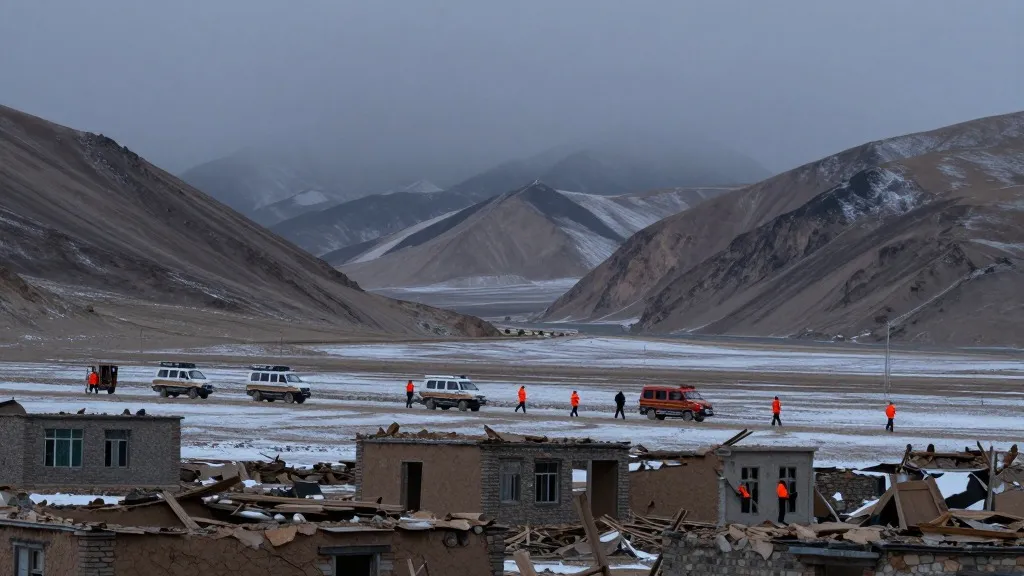
Search and rescue crews continued working through the early hours of Friday after a powerful magnitude 7 earthquake struck northern Tibet on Thursday evening. The seismic event has killed at least 16 people and injured 46 others, with the most severe destruction centered around the city of Nagqu.
Local officials reported that the quake caused hundreds of structures to collapse. The Nagqu media office stated that at least 339 homes and 20 livestock sheds had fallen. Among the 46 injured, 11 are in serious condition, while the other 35 sustained minor wounds. Rescue operations remain active as workers comb through the rubble for survivors.
The scale of the response has mobilized more than 1,600 personnel from the local county. Logistics teams have begun delivering essential aid to the affected zone. This includes 1,000 prefabricated housing units, approximately 3,000 tents, folding beds, flashlights, and winter clothing, which is critical given the region's climate.
Infrastructure damage has further complicated the relief efforts. Xinhua reported that communication lines were down in parts of the area. Railway authorities took emergency measures to halt train traffic through the zone. Additionally, rockfalls forced the closure of a section of National Highway 317. Only emergency, rescue, and official support vehicles are currently permitted to pass while crews clear the debris.
Weather conditions pose an additional challenge for the teams on the ground. Xinhua indicated that intermittent snow is expected across the quake zone over the next three days. This weather pattern may slow down the pace of recovery and increase the difficulty of transporting supplies to isolated communities.
CCTV, China's national broadcaster, characterized this event as the largest earthquake to hit the region in the last five years. The magnitude of the shock has raised concerns about long-term stability in the area, prompting a sustained governmental response.
The U.S. Geological Survey provided specific details on the tremor, noting it occurred at 10:33 p.m. local time. The quake registered at a depth of 18 kilometers. Its epicenter was located 191 kilometers east-northeast of Nagqu, in a sparsely populated, high-altitude section of northern Tibet.
Geographically, Nagqu is situated more than 300 kilometers north of Lhasa, the capital of the Tibetan region. The remote nature of the epicenter means that many residents live in areas where access to medical care and emergency services is already limited, making the current rescue and relief operations vital for the community's immediate survival.
Source: CBC News